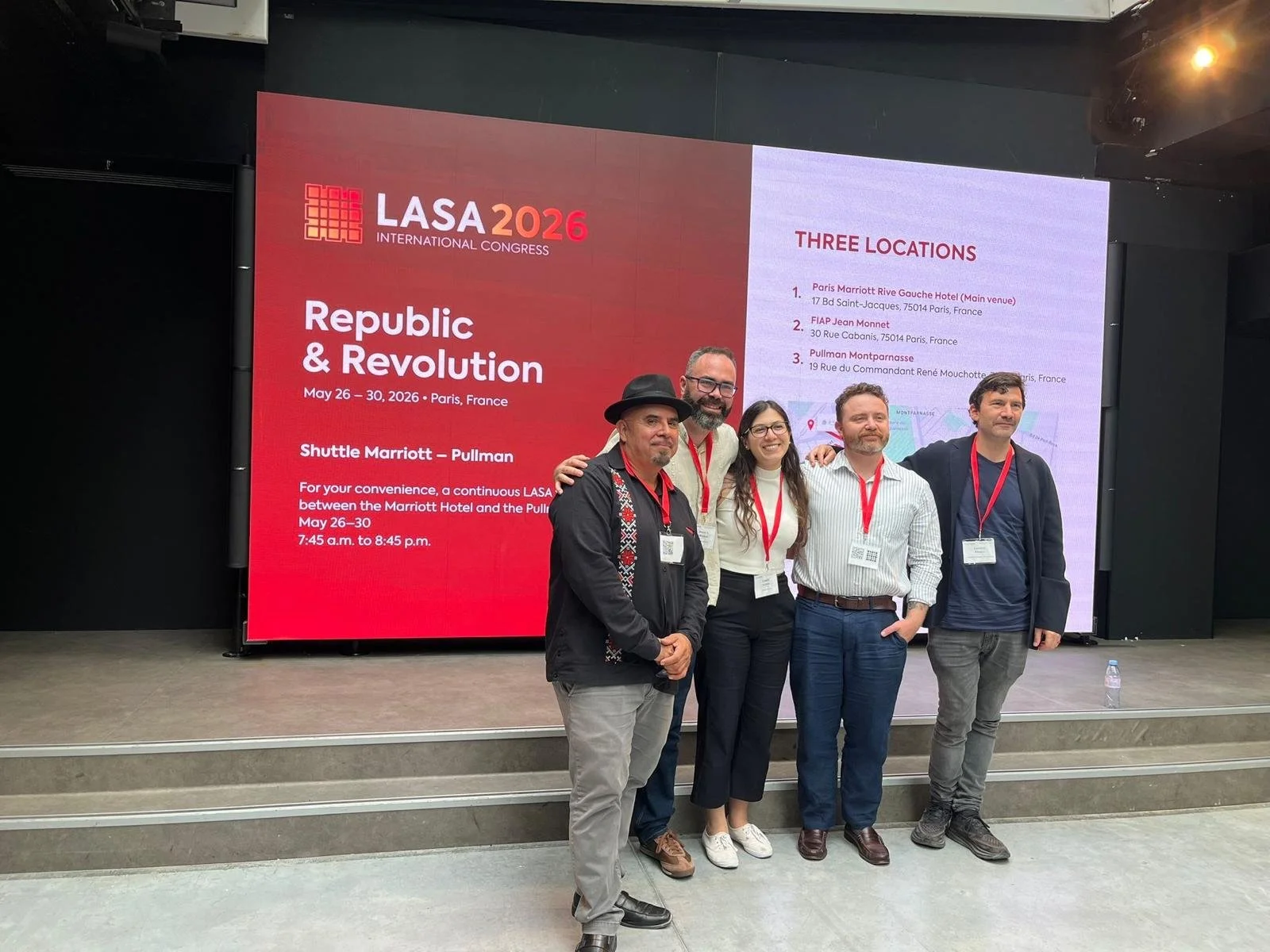
Presenting at the Latin American Studies Association International Congress in Paris 2026.
My research sits at the intersection of political sociology, political economy, comparative politics, and the sociology of race and class inequality. I study how transformations in capitalism — economic restructuring, class recomposition, and the unraveling of the postwar social contract — create the conditions under which far-right and authoritarian movements build mass constituencies in the United States and Latin America. My scholarship combines extensive qualitative fieldwork, interview research, and original survey data with sustained theoretical analysis, and is animated by a commitment to building the empirical and theoretical groundwork for understanding — and resisting — the contemporary authoritarian turn.
I am currently at work on my first monograph, The Crisis of Neoliberalism and Far-right Politics in Southern California, under review with Oxford University Press (Subaltern Latino Politics series). Drawing on 60 semi-structured interviews, three years of fieldwork, and original survey data, the project investigates the rise of far-right political movements among White and Mexican American communities in Southern California's Inland Empire. I situate these politics in relation to the region's histories of settler colonialism, capital accumulation, and racial authoritarianism, and to the fragmented and volatile class relations produced by the crisis of neoliberalism — asking how economic precarity is translated, through organized political and religious networks, into nationalist and authoritarian grievance. Through comparative and theoretically grounded analysis, the study shows how far-right politics is articulated and legitimated differently across race and class, and contributes to a growing body of scholarship that seeks not only to explain the contemporary far right but to build the theoretical and empirical groundwork for resisting it.
My next project, A Time of Monsters: Capital, Uneven and Combined Development, and Far-Right Politics in the Americas, extends this agenda to Latin America. Over the past decade, far-right and populist movements have surged across the region, posing significant threats to democratic institutions, the environment, and historically marginalized communities, including women, Indigenous communities, Afro Latinxs, LGBTQ+ people, environmental activists, and working-class people more generally. Building on my research on the U.S. far right, this comparative project examines how uneven patterns of capitalist development, labor precarity, and migration shape the conditions under which these movements achieve legitimacy — and how their ideological repertoires travel — focusing on Argentina, Brazil, México, and Colombia.
My previously published research examines social movement mobilization, social justice, and the policing of Latinx communities in Southern California.
Book projects

“¡Los hombres, no las armas, deciden!” Elizabeth Catlett [Dibujo] y Alberto Beltran [Grabado](1950)
Publications
Peer reviewed journal articles:
Book chapter: (forthcoming):
Scott, Alexander. “Neoliberal Capital Accumulation and the Crisis of Rightwing Authoritarianism in Southern California’s Inland Empire.” Book chapter for an edited volume in the Studies in Subaltern Latina/o Politics series from Oxford University Press. Edited by Juan De Lara.
Special Issues of Journals:
Public Scholarship:
Lola Smallwood Cuevas; Semi Cole; Ellen Reese; and Gary Rettberg; with Sara Bruene, Matthew Byrne, Christian Guerra, Luis Higinio, April Celeste Leviton, Bernabe Rodriguez, Ardcha Premruedeelert, and Alexander Scott. 2020. Ain't No Sunshine: The State of Black Workers and Demands for a Brighter Future for the Inland Empire. Riverside, CA: Future Inland Empire Black Worker Center Project (IEBWCP) Advisory Group, Center for Social Innovation at UCR, Labor Studies Program at UCR, and Los Angeles Black Workers Center.
Under Review:
Scott, Alexander. Empire of Reaction: Capital, crisis, and the multi-racial far-right in Southern California’s Inland Empire. For submission to the Subaltern Latino Politics series at Oxford University Press.
Scott, Alexander. “Neoliberalism, Authoritarian Populism, and Far-Right Latinx Politics” For submission to Race & Class.
Other Publications & Featured Interviews for Latin American Perspectives: